One of the more enjoyable things we did in Cork was join a science fiction/fantasy reading group. In February, we read the literary SF novella This Is How You Lose The Time War. It reminded me of nothing so much as the experimental early 70s fiction of Josephine Saxton or Carol Emshwiller, a well i have not dipped into in too many years. The story concerns soldiers from two different cultures, Red and Blue, one gardeners, the other mechanics, who are battling throughout history creating alternate timelines in the hope that, as Feynman might have understood, the sum over histories will favor one over the other.
Not everyone’s cup of tea, but that’s OK. It is, supposedly, being prepped for a TV series, and whether it translates or not, well, we’ll see. It’ll need a lot of Doctor Who type elements to make it work effectively.
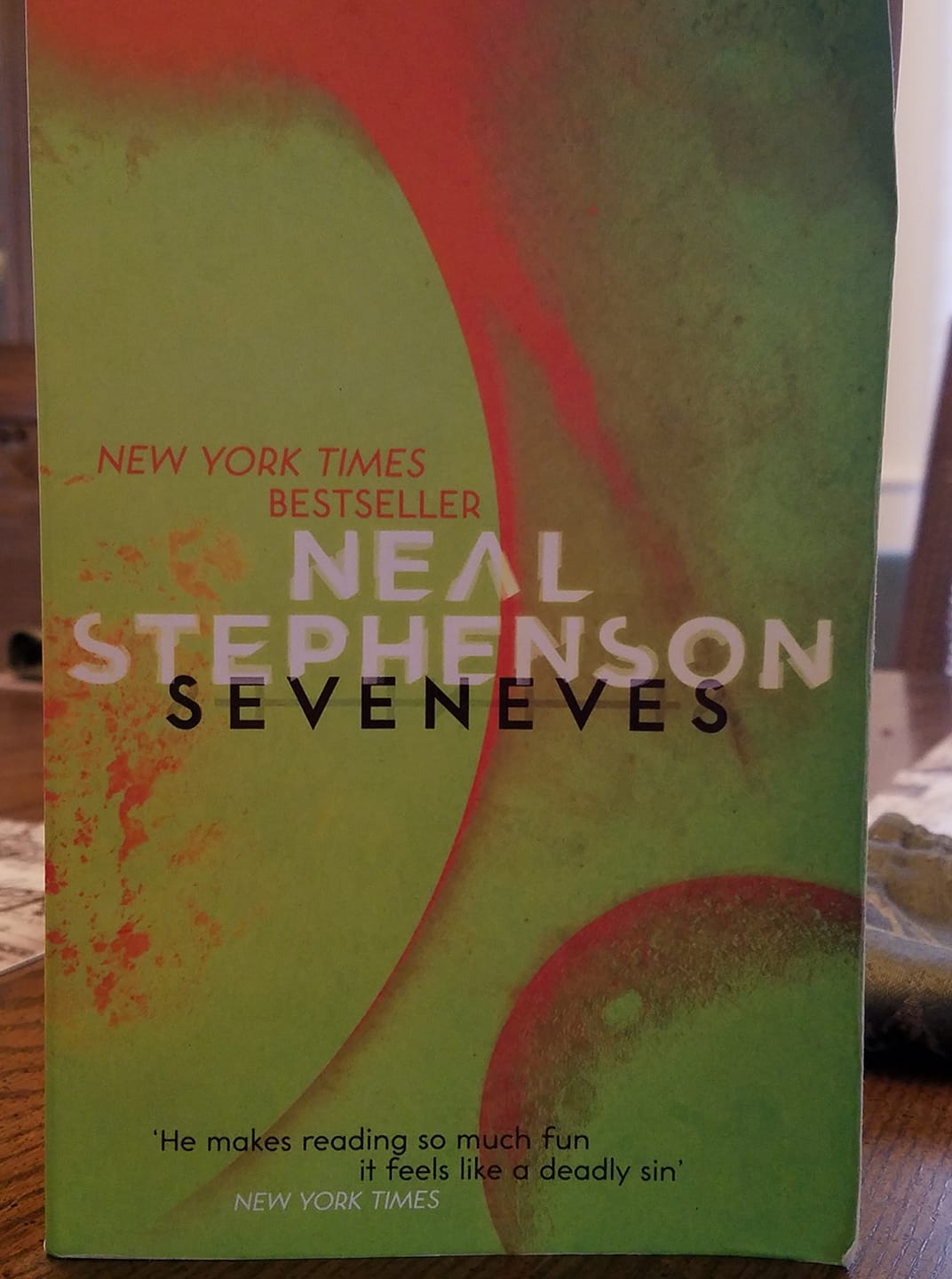
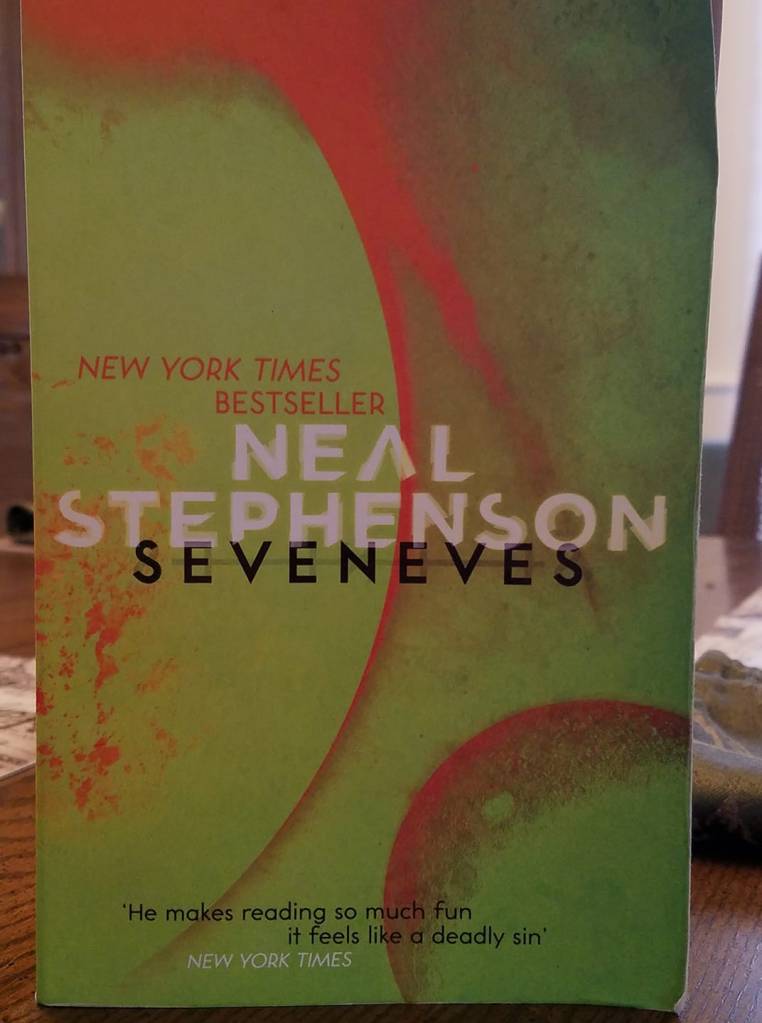
For March, the group decided to read Neal Stephenson’s massive 900 page 2015 novel Seveneves. As it turns out, we’re not meeting in March. But i read this thing, and i had a lot of reactions to it, and given who i am, i’m going to share them here. Because, man, it was a lot of effort to get through this book.
There will be spoilers. You have been warned.
For starters, let me say that this sort of “hard” SF is not my personal favorite sub-genre. But i am neither averse toward good examples of it, nor ignorant of its history. I read The Foundation Trilogy in my teen years. My Heinlein collection spans almost a foot on my bookshelf. I’ve read Joe Haldeman, and Arthur C. Clarke. Larry Niven. Stephen Baxter. More contemporaneously, i’ve enjoyed Kim Stanley Robinson’s Mars Trilogy, Paolo Baccigaluppi’s Wind-Up Girl, and Cixin Liu’s Three Body Problem. I’ve even read Stephenson before, though i won’t say that Snow Crash was one of my favorite reads.
This book, though, was a turd. No exaggeration to say that it is one of the worst books i’ve ever picked up, from its abhorrent concept, through its ignorance of any science (linguistics, sociology, archeology) that is not orbital mechanics, through its author’s disdain for his craft. It is an utter waste of time and paper.
Briefly, an “Agent” passes through the Moon, causing it to split into 7 large, asymmetrically divided, pieces. The “Agent” is never identified, but the most reasonable hypothesis is a micro-sized black hole. It doesn’t really matter, because once the orbital mechanics of the 7 pieces are calculated, the Neal deGrasse Tyson lookalike character in the novel figures out that the resulting collisions among the 7 pieces, and the fragments they will create, will turn into a “hard Rain” in about 24-30 months, which will drop into the greatest meteor shower ever seen on the earth, raising the surface temperature to 500° F and incinerating all life, including the microscopic and sea life, as the oceans are boiled off.
Being the intelligent, foresightful creatures that evolution has shaped us to be, the smartest, best equipped to survive and repopulate the earth segment of the human population, are sent into low earth orbit on board an expanded International Space Station (called Izzy in the future because nothing defines humanity so much as our ability to give things cute names). But because Hillary Clinton has won the 2016 election and is now the most powerful person on the planet, there is also a program in place to randomly select representatives of every planet and culture on earth to join these more qualified folks in orbit, and make sure the new earth to be born out of the ashes of the old gives equal weight to all cultures, and Stephenson’s disdain for the notion that, yeah, all cultures are equal, and none are intrinsically superior to any others, could hardly be more palpable. (It’s not “actually” Hillary Clinton in office, any more than “Doob” Dubois is “actually” Neal deGrasse Tyson, or Sean Probst is “actually” Elon Musk, but you’d have to be an idiot not to see what Stephenson is doing with these characters.
Of course, the program to choose these “multicultural” representatives is the most cynical thing ever constructed, and most of the candidates chosen this way are sent immediately to their deaths, and those that aren’t are shuttered off into portions of this orbital sanctuary that are not going to protect them from the dangers of space, because politicians, especially liberal politicians, don’t really care about people, just about perpetuating their own hold on power. So it’s no surprise when Hillary Clinton violates all protocols and laws and manages to get herself inserted onto the last orbital vehicle leaving the earth and onto the space station. Where, and you’re not going to believe this, she consolidates “political” power against the scientists who are only making the most rational decision about who should live and who should die, and the most statistically correct decisions about which parts of the space station should be protected against cosmic rays and accidental collisions.
As it turns out (and it’s not an accident that i use this phrase, and we’ll get to that in a bit) those decisions turn out to be wrong, but it’s not their fault, and they definitely should be allowed to continue to hold decision making power because democracy is bullshit and only technocrats removed from the people can make correct decisions, and all of the genetic material sent up to space to help perpetuate the human race is destroyed in the first week after life on earth is wiped out, and Jesus H. Christ how are we going to reseed the planet in the future now?
Well, the technocrats come up with one plan, and the humanists come up with another plan, but of course the humanist plan doesn’t allow for the dangers of space (at least the ones we follow; there’s another, break-away group which supposedly leaves to go and try and colonize Mars, and although we’re supposed to assume they died in the effort, Stephenson never really follows up on what happens to them, so maybe they’ll pop up, deus ex-machina style, in the sequel, not unlike two groups do in the last 75 pages of this book.
Anyway, about 2/3 of the way through this book, everybody on earth is dead. Virtually everybody on the satellite who was sent up to save the human race from extinction is dead. Except for 8 people. Who are all women. (All of the men are dead, having heroically sacrificed their lives in order to give the others a fighting chance. Because that’s what men do, right?) And one of the women is too old to bear children. So that leaves seven women to create the new human race, and by god, they’ll be known as the Seven Eves.
Did i mention Seven Eves is a palindrome? A palindrome is a sentence, group of letters, or numbers, that can be read forward or backwards, exactly the same. Perhaps the most famous example of a palindrome is ‘A Man, A Plan, A Canal, Panama.” Do you see how if you start from the beginning or the end, it can be read the same? Palindromes are actually totally devoid of any literary or cultural significance, other than that they’re cool. They’re as cool as fezzes to Matt Smith’s Doctor Who. Matt Smith, of course, was not as good as David Tennant, but he was charming in his own way. And the Vincent Van Gogh episode was particularly a classic. But Smith was definitely a cut above Peter Capaldi, yeah? And Karen Gillan, even though she was a bit of a waif at the beginning, was definitely hotter than Jenna Coleman, who, while not without her charms, lacked a certain quirkiness that we’ve come to expect in the Doctor’s companions. But of course, Billie Piper had been the best of the revived Doctor’s companions without question. She had been selected for some reason which no one now could remember, but maybe being blond had something to do with it. But her performance had been collectively seen as the best, and she had been recognized by all of Whodom as the ideal companion for all the others to strive for.
Where was I?
Oh, yeah, so now, we’re 2/3 of the way through the book, and everybody is dead except for these 8 women, only 7 of whom can bear children, who will be called on to re-populate the human race. By sheer coincidence of the necessity of the plot (because it is here that Stephenson’s real game become apparent, and it is even more hideous than you can imagine) these 7 women represent 7 different cultural and ethnic groups from what will henceforth be know as “Old Earth.” Because, over the next 5000 years, nothing about language will change for anybody who speaks it thanks to the magic of digital recording, except when it’s necessary for specific things to happen in the plot. Thankfully for the future of the human race, one of the 7 is a master manipulator of genes. She’ll be able to, with some modicum of success, create Y chromosomes within a generation or two of the womb creation portion of the program. And then, if we’re lucky, sexual reproduction and sharing of genes will create a heterogeneous population best suited for survival on a future terraformed planet.
Oh again, that’s not Stephenson’s game. See, as it turns out, what Stephenson is really trying to do is create an environment in which the disgraced science of The Bell Curve might actually be applicable. And these seven Eves are given the ability to choose which traits they want their offspring to possess. And one of them, i swear to god, want her offspring to be imbued with the exclusively masculine trait of “heroism.” And so the descendants of these seven Eves basically only make babies with others of their “race”, which should end up with seven pretty much inbred and useless groups of people, but that would defeat Stephenson’s purpose, which is to demonstrate the “scientific” basis for racism.
Because the final third of the novel takes place “Five thousand years in the future.” Which happens to be the time that the earth’s surface has stabilized enough for the re-terraforming efforts to be achieving some success, and colonies from the 3 billion descendants of the seven Eves to start resettling the planet. It was obviously easier to title a subsection of the book “Five thousand years later” than it was to tell any stories about what might have actually happened during that time. Or to figure out how humanity, which took approximately a quarter of a million years to expand it’s population to a billion the first time around could, on a bunch of artificial satellites, have achieved that sort of population growth in one fiftieth of the time on this go round. (Yeah, it’s true, humanity went from 1 billion to 3 billion in a century or less. But the first billion is the hardest.) And oh, did i mention, it wasn’t really “seven” Eves, it was more like 6 1/2, as one of them was about 50 years old, and only had enough time for one child before menopause. Oh, and really it was 6, because one of the others tried a number of genetic manipulations which were unsuccessful, and all of her offspring died, except for 1.
But anyway, 5 thousand years in the future, when there’s 3 billion people, who all are members of distinct “races” with distinct social and psychological and physical characteristics, and everybody’s actions and attitudes can be predicted by knowing which Eve they are descended from, all shit breaks loose, when it turns out there are not one but two groups of descendants of humans who have survived on the actual surface of the planet, one underground, who are actually cousins of one of the Eves, whose father was a miner and who was a real self-sufficient American man who figured out a way to hold a culture together underground, and one underwater because apparently although the seas boiled off during the Hard Rain, they didn’t actually boil all the way off, and these submarines, which were the same ones used to nuke Venezuela under Hillary Clinton’s order (remember there was a character based on Hillary Clinton? You won’t believe what happens to her after she lies and schemes to get on the satellite and foments a democratic overthrow of the rational technocrats) and whoa, you won’t believe that there’s a whole race descended from Hillary Clinton, and man are they just horrible people.
But this shit isn’t even the worst part of the book.
No, i’m kidding, the attempt to write a 900 page justification for racism is the worst part of the book.
But there are others that come close.
Moby Dick is widely considered to be the first Great American Novel. One of its defining characteristics is just how little of the text is devoted to advancing the narrative of Ishmael, signed up as a crewman aboard the Pequod under the command of the insane Captain Ahab, whose obsession with tracking down and killing the whale who took his leg and his previous command drives the novel. But we also get Melville’s almost encyclopedic knowledge of everything about the practice of whaling, entire chapters devoted to descriptions of the harpoons and their functions, the rendering engines, the winches that tie the dead whales to the boats in order to extract the oil to be rendered, the wood on the deck, the social structures of Nantucket Island, basically everything necessary to run a nineteenth century and understand the relationships that exist therein. It’s the kind of distraction from the plot that Tom Robbins excels at, and also Thomas Pynchon. It’s the kind of thing about which that book reviewers will often say, “Robbins skillfully navigates the Scylla and Charybdis of exposition and info-dump that in the hands of a lesser writer would render the text into a 900 page boat anchor.”
Friends, Neal Stephenson is that lesser writer.
His info-dumps are pedantic, repetitive, and almost singularly focused on orbital mechanics. I’m sure he gets that right. In fact, i remember most of them from Frank Reynolds’ coverage of the Mercury, Gemini, and Apollo missions of the 1960s. But Stephenson uses a lot more words to convey the same information. It’s practically a paean to mansplaining. And all told in the passive voice.
But, then, he passes several opportunities where a little exposition would be wonderful.
I read the 2016 Borough Press trade paper edition, so that’s where the page numbers come from.
On page 191, Doob (aka Neal deGrasse Tyson) is in Bhutan to help select and congratulate the two young people who have been chosen to carry that particular culture into the future. Here’s the quote: “The King drove him up the mountain in his personal Land Rover, Doob riding shotgun in the passenger seat on the left—for Bhutan, as it turned out, was a drive-on-the-left country.”
As it turned out?
Seriously? As it fucking turned out?
There are reasons why one country uses the drive on the left system, and another country uses the drive on the right system. It’s not the result of a coin flip. There wasn’t a game of Ro-Sham-Bo 2500 years ago which determined whether chariots would pass each other on the right or the left. There’s a knowable history behind which countries practice one system or the other.
But describing that history, because it delves into imperialism, military conquest, and some of the less palatable aspects of western civilization, has no place in Stephenson’s game; which though he takes great pains to hide, is nothing less than the rationalization of racism as a legitimate foundation of culture.
Oddly enough, when i researched the history of Bhutan for this essay, i learned that the various Buddhist nations of Nepal, Tibet, Bhutan, and their sub-kingdoms and fiefdoms, spent as much of their past in military adventurism against each other as the Europeans over the past 1500 years, or the Biblical tribes of Israel and their neighbors. But that the Bhutanese alliances with the British in the 18th and 19th centuries would likely explain how, as it turned out, the Bhutanese, like the Irish and the Australians, drive on the left. It would certainly have been worth a couple of paragraphs for Stephenson to go down that, um, road. I mean, with 900 pages, he had some to spare.
There’s no shortage of language, whole paragraphs of it in fact, that have the effect of stopping the reader dead in their tracks. And not in a good way. About 8 years ago, i read Gene Wolfe’s “Peace.” About 2/3 of the way through the book, there’s a scene where two people are driving through a rainstorm in a 1940s sedan. Wolfe writes “The wipers sponged generations of raindrops from the windshield as she spoke.” I hit that sentence, and had to put the book down, it was so beautiful. I spent an hour just contemplating the imagery of “generations of raindrops.” I wrote a FB post about how good it was.
Last year, i reread Peace. And while reading it, i honestly forgot about my previous reading. It was a new book to me. Until i hit that sentence, and it knocked me out again. And when that happened, i thought, didn’t i write something about this before? And i looked, and found my years old FB post. That’s the power of someone who cares about the craft of writing.
I hit the sentence “Forward the ice flowed,” in Seveneves, and i had to put the book down. For precisely the opposite reason as the Wolfe.
This was possibly the single ugliest sentence i have ever read in a novel.
If you want to tell the reader that a particular chunk of ice moved in a particular direction, you can write “The ice flowed forward,” and it accomplishes your goal perfectly. If you want to tell the reader that a particular chunk of ice moved in a particular direction, and that direction is significant, you can write “The ice flowed, forward,” and it still gets the job done, perfectly.
If you want to tell the reader that a particular chunk of ice moved in a particular direction, and that you understand somewhat how the cadences of language can make a sentence more or less pleasurable you can write “Forward flowed the ice,” and while it’s less elegant than the previous examples, at least forward is modifying the word that follows it. The sentence actually moves in a direction that reflects the action.
If you want to tell the reader that a particular chunk of ice moved in a particular direction, and that you really want to call attention to the fact that you are trying to impress people with your showy language skills that really aren’t very skillful, you can write “Forward the ice flowed,” and you will accomplish that effectively.
Man, i had to walk away from this book for a day after slamming into that brick wall.
Unbelievably, there’s more. Stephenson will write entire paragraphs that take up multiple pages of exposition that consist of a dozen or more sentences all containing the same “There had been an effort to determine which of the members of the crew should do such and such. And as a result there had been a decision made that resulted in other decisions being made, which had been required to make a decision that no decisions would be made,” construction. That’s bad enough. But then, in the last third of the book, he ascribes the ability to use this exact same “passive voice” construction to one of the seven races of his survivors, in a very deprecatory way. Something along the lines of: “Like all members of her race, she was skilled in using the passive voice to deflect any notion of responsibility for a decision that they had, in fact, consciously taken.” And his inability to recognize his own guilt, and the bias he brings to assigning favor and discredit to the various races and factions he supports or tries to discredit, is appalling.
At one point in the final section, he has one of his characters recognize that she is engaging in what he quaintly refers to as “The Old Racism.” Of course, she’s a descendant of the Black Eve, and she’s feeling prejudice towards one of the descendants of one of the white Eves. But despite describing Every. Single. Character. in the last third of the book by their racial characteristics, not only physical manifestations but also psychological predilections, aptitudes and intelligences, Stephenson is either in denial, or, rather more incredibly, ignorant of the racism he is bringing into play. The number of times he frames a character description with some variation of “As a member of this race, so and so was naturally inclined to believe such and such,” was beyond my count. About the only good thing you can say is that Stephenson’s racism is actually not as malign as his misogyny. He literally has one of his Eves make the conscious, verbal decision, during the end of the second part of the book where the seven Eves are going to determine which characteristics they want to pass on to their descendants (and because they are all women, there’s no possibility that any of them will consider any form of cooperation to benefit the whole group, just what they can do to privilege their own descendants against the other races) that she will give her descendants the masculine trait of “heroism.” And i wanted to gouge my eyeballs out.
No, i wanted to gouge Stephenson’s eyeballs out.
In short, this book sucked ass. Though i’d lay even money it’s Jordan Peterson’s favorite SF novel of the last generation.
 Cork Spring